You cannot control how your body gains weight in recovery and this truth can feel scary and confusing. This blog looks at why our bodies respond the way they do and what to expect during the process of healing.
Read More
You cannot control how your body gains weight in recovery and this truth can feel scary and confusing. This blog looks at why our bodies respond the way they do and what to expect during the process of healing.
Read MoreLearning to tolerate fullness in early anorexia recovery can feel almost impossible, but I am here to reassure you that it is and explain why it is such an important step in your recovery journery.
Read MoreWhat does “clean eating” really mean? Learn how clean eating culture can fuel food anxiety, guilt, and eating disorder behaviours.
Read MoreDiscover the role of protein in eating disorder recovery, muscle repair and appetite regulation - without falling into high-protein diet culture extremes.
Read MoreLearn why dietary fat is essential for hormone balance, brain health, and recovery from disordered eating and why low-fat diets can prolong symptoms.
Read MoreCarbohydrates are one of the most feared food groups in eating disorder recovery. Diet culture labels them as “fattening,” “addictive,” or something to be controlled. But biologically, carbohydrates are not optional - they are essential.
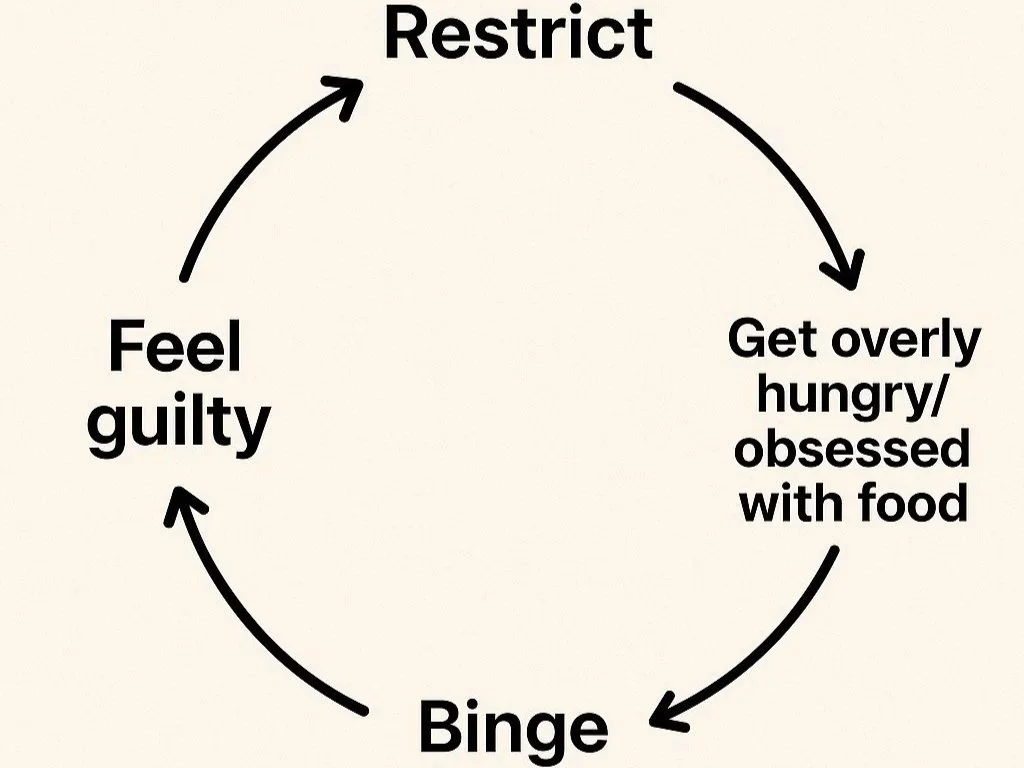
Read MoreClear food rules can create the illusion of safety and control but many popular diet culture beliefs are not supported by evidence and can actively maintain restriction, binge-restrict cycles and food anxiety.
Read MoreBeginning to nourish your body after restriction can feel overwhelming. Here’s what to expect physically and emotionally in early eating disorder recovery.
Read MoreA physiological response to under eating is to over eat! This is not about willpower, it is about biology and our bodies amazing drive and desire to keep us fed and… alive!
Read MoreUnderstanding that there is a genetically pre-determined weight range your body wants to sit within can be liberating as it allows you to let go of control and shift your mindset towards self-acceptance and redefining your relationship with food.
Read MoreGLP‑1 receptor agonists have rapidly become headline-grabbing solutions for weight loss. These medications lead to significant appetite suppression and weight reduction which has made them incredibly appealing not just to those with clinical obesity, but to anyone feeling pressure to lose weight fast. But this trend is extremely concerning, especially for people living with eating disorders, whether diagnosed or not.
Read MoreThe key to healing your relationship with food is to forget everything we have previously been taught! Instead of food being “good” or “bad”, what if we could just view it as “food”? Instead of having rules which drive restriction and compensatory behaviours, what if we could allow ourselves to listen to our bodies, recognise our wants and needs and respond to them calmly and with compassion.
Read MoreWe live in a world and society where we are CONSTANTLY exposed to narratives and visuals telling us that we need to change the way we look, that if we don’t match up to society’s curated vision of beauty then we aren’t good enough but, it is possible to learn how to drown out this noise and start to really not give a cr*p.
Read MoreWith calorie-tracking apps, sleep monitors, step counters, and a plethora of wearable devices, we can now monitor almost every aspect of our well-being and ironically, rather than improving our health, all this data might actually be increasing anxiety, disordered eating and body dissatisfaction.
Read MoreHere’s the truth: health is not a size, a weight, or a look. It is a collection of behaviours - not rules - that help you feel safe, nourished, whole and, support both mental and physical wellbeing.
Read MoreWhen you're trying to heal your relationship with food, being told that 30g of pasta is a “serving” (when you know that’s barely a mouthful) can create shame, confusion, and anxiety. So, why are serving sizes so small, why do we need them and who sets them?
Read MoreWe are human, we are unique, let’s stop trying to fight our genetics and instead respect and learn to accept them and our bodies because, really, our weight is the least interesting thing about us!
Read MoreMany eating disorder clients I see have grown up in households where food and experiences around food have not been positive. Fostering a positive relationship with food in children, at a young age, is key when it comes to them being able to make food choices for themselves later down the line.
Read MoreBox breathing can be an extremely useful tool if you are feeling stressed, anxious, panicked and you need to ground yourself.
Read MoreAnorexia nervosa is often associated with extreme thinness, but the reality is that this eating disorder can affect individuals of all body sizes, including those in larger bodies.
Read More